Your Own VPN Server

Verifiable Privacy
Dedicated IP
Censorship Ready
No Device Limits
SHP is a VPN service with your own fast, secure personal server deployed in minutes. You get a dedicated IP, private infrastructure, and full control over your traffic.
Get your personal VPN server
Get your VPN running on a private server and start working through a secure environment in less than 10 minutes.
CHOOSE YOUR SERVER
Select a VPN protocol, a plan, and a server location.
WAIT FOR SETUP
Your personal VPN server with a dedicated IP address is being configured automatically.
CONNECT
Install the app on any of your devices and connect using a config or QR code.
Watch how to use a VPN with your own server

Effortless Start
When your server is online, your virtual private network software is ready to use. Our VPN service automatically configures the network, firewall, and protocol for you.

Anonymous Signup
Create a password and keep your system ID. No email. No KYC. and start using your anonymous VPN with no extra steps or procedures.
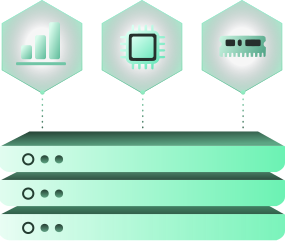
Personal Server
Instead of a shared online VPN service, you get a VPS isolated from other users. For you, this means that your traffic won't pass through the same server as other users, and your connection is secure.
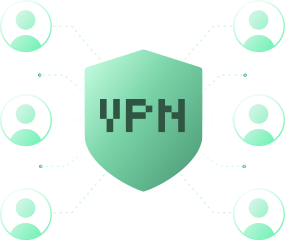
No Device Limits
Connect as many devices as you need using the web panel. Performance scales with your plan.

Verifiable Privacy
Root access lets you confirm logging is disabled. As a safe VPN service, we believe you have the right to verify privacy yourself, not just take our word for it.

Censorship Ready
We support multiple protocols, built for networks that block or filter traffic. With a private VPN server, you choose the protocol that gets through.

Fast. Personal. Worldwide.
Run your private VPN through 40+ global locations without sharing infrastructure with random users. Choose the right VPN server for better speed, lower latency, and access to the services and content you need.
FIND THE RIGHT PROTOCOL FOR YOU

Our VPN Service vs Other VPN Providers
Regular services promise you a high-speed VPN, but in reality, this speed gets divided among hundreds of users, which means less control and a slower connection. Self-hosted VPN is a personal solution: you get your own server and IP address with more options to manage your connection.
| Feature | SHP | Other VPNs |
|---|---|---|
| Own server | ✖ | |
| Dedicated IP | ⚠ A dedicated IP is always an extra paid add-on with limited location choices. | |
| Proofable privacy | common:homeComparison.tooltips.proofablePrivacyShp | ⚠ Even providers that have passed a security audit don't give you access to their servers. |
| Protocol flexibility | WireGuard, OpenVPN, IKEv2, OpenConnect, Outline, VLESS+Reality, Hiddify already available | ⚠ Usually only WireGuard and OpenVPN. |
| Customization | ✖ | |
| No device limit | Each server allows connections up to its technical limits | ✖ |
| Stable performance | ⚠ Popular locations are often congested, and peak hours make it worse. | |
| Instant location swap | ✖ Up to 15 minutes (server redeployment required) |
FAQ
With SHP, you get your own server plus a dedicated IP, so you're not sharing resources with a crowd.
That usually means steadier performance on busy networks — and a private connection by default.
However, laws and enforcement can change, and some places either ban VPNs outright or heavily restrict how they can be used.
Specifically, VPNs are illegal in Turkmenistan, Iraq, Oman, Belarus, and North Korea.
They are strictly restricted in China, Turkey, russia, Iran, United Arab Emirates, Myanmar and Egypt.
The slowdown isn't critical for stable browsing, streaming, or gaming in most cases.
However, the farther the VPN server is from your device, the longer your data has to travel, resulting in higher latency and lower speeds.
Protocols handle encryption and routing differently, so performance may vary.
If too many users share one server, speeds drop.
If your internet connection is already slow or congested due to Wi-Fi issues, ISP routing, or peak hours, a VPN can't fix it. In fact, performance may feel worse.
They may restrict speed, data usage, available locations, or even inject ads or track activity to cover their costs.
With SHP, you're paying for your own personal server, which gives you a dedicated IP and consistent resources, so performance and stability don't depend on how many other users are online.
Advanced plan is for everyday device usage with an active monthly traffic.
Family plan is for household usage and higher traffic needs, especially when multiple people use the server.
Team plan is for shared usage with heavier demand and more consistent load across devices.
Pro plan is for serious workloads and maximum headroom, including using the VPS for more than just a VPN.
You can compare available plans here.